

The History of Bone Beads: From Ancient Ornaments to Today
Bone beads might look like a simple, modern boho staple, but they are among the oldest forms of jewelry people have made. Long before metal, glass, or cut gemstones, our ancestors were shaping bone into beads and threading them on cords. Here is a short tour through the history of bone beads, and how that tradition continues in the ox bone beads we carry today.
Why Bone? A Material Within Reach
Bone was one of the most available materials in the ancient world. It is strong, it can be cut and smoothed with simple tools, and it takes a polish. Early people could turn a hollow bone into a tube bead by cutting it into short lengths, smoothing the ends, and threading it on a string or strap.
The Earliest Beads
Researchers think the earliest personal ornaments, mostly beads, first appeared in Africa during the Middle Stone Age, and later in Eurasia in the Early Upper Paleolithic. They are treated as a sign of growing social and cultural complexity, since people wore them to show identity, status, and belonging.
At Denisova Cave in the Altai Mountains of Siberia, archaeologists have recovered more than 50 tubular bone beads from layers dated to roughly 40,000 to 38,000 years ago. Wear marks on these beads show they were threaded and worn against clothing or skin, as parts of clothing, necklaces, and possibly bracelets. Making them took several steps: selecting the bone, shaping it, decorating it, cutting it into short tubes, and smoothing the cut ends.
Bone Beads in the Americas
In North America, a tubular bead made from hare bone was found at the La Prele Mammoth site in Wyoming. It dates to about 12,940 years ago and is the oldest known bead in the Western Hemisphere. Both ends are smoothed and polished, and researchers believe it was used to decorate the body or clothing. Hare bone beads later became a common practice in western North America.
Tubular bone beads continued to matter in later Native American traditions. Long bone beads known as hairpipe became a signature element of regalia, including breastplates and necklaces, and many were later made for trade.
A Craft That Crossed Continents
Across Africa, Asia, and the Americas, bone beads were worn as everyday adornment, traded between communities, and used in ceremonial dress. Because bone is a byproduct of animals people already used for food, it stayed an accessible material for people at every level of society.
Bone Beads in India Today
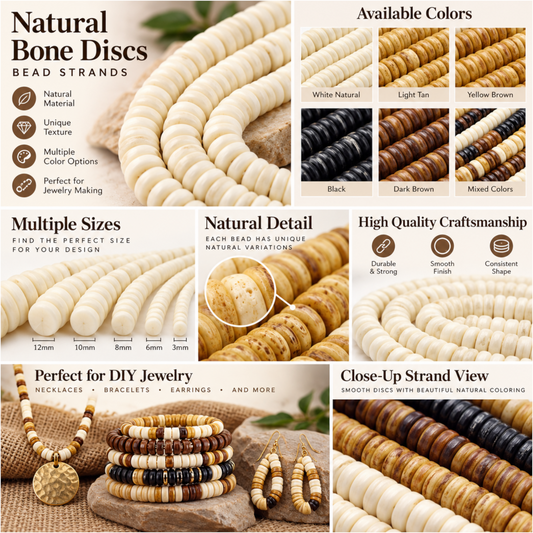
India has a long tradition of carving bone, horn, and other natural materials, and it remains a center for bead making today. Our bone and horn beads are made from ox bone in India, where artisans cut, carve, and finish each bead. You can see that craftsmanship in our hand-cut Indian beads and in carved shapes like arrows, crescents, and tusks.
Why Bone Beads Still Appeal
- They are lightweight, so even long strands are comfortable to wear.
- They are natural, with small differences from bead to bead that make each piece one of a kind.
- They are versatile, pairing easily with wood, metal, and gemstone beads.
- They connect you to a very old tradition of making and wearing beads by hand.
Make Your Own Piece of the Tradition
You can carry on the tradition with a necklace of your own. Our guide, How to Make a Bone Bead Necklace, walks you through it step by step. Or browse our bone and horn beads to find shapes and sizes for your next project.
Sources
- Surovell, T. A. et al. (2024). Use of hare bone for the manufacture of a Clovis bead. Scientific Reports, 14.
- Shunkov, M. V., Fedorchenko, A. Y., and Kozlikin, M. B. (2023). Early Upper Paleolithic Tubular Beads from the Main Chamber of Denisova Cave. Archaeology, Ethnology and Anthropology of Eurasia, 51(4).
Tags:
Related articles
-
Oct 22 2026
How to Make a Bone Bead Necklace: Step-by-Step Guide
-
Aug 17 2025